Background
In early Ethereum, validators built their own blocks. They would look at the mempool, pick the transactions with the highest fees, order them, and propose the result. This was simple and fair enough when block construction was straightforward. But as on-chain activity grew, block construction became a competitive, technical challenge. The order in which transactions appear inside a block affects the block's value. A validator who could strategically order transactions stood to earn significantly more than one who simply sorted by fee.
This created a problem: to stay competitive, validators would need to run sophisticated ordering algorithms and low-latency infrastructure. Solo validators running a node at home could not compete with professional operations. If block construction remained a validator job, the validator set would centralize around a few well-funded operators.
The solution was to separate the two jobs. Let sophisticated builders handle block construction. Let validators focus on proposing and attesting. This separation is called Proposer-Builder Separation, or PBS. Within 60 days of the merge over 90% of validators had adopted PBS, and more than 90% of Ethereum blocks are still built through it.
While PBS is robust and has successfully preserved validator decentralization, it has remaining structural gaps which MPBC starts to address. A full primer on Ethereum's transaction journey for new readers is available on the Blockspace Forum's website with a short description provided below.
The PBS pipeline
Under PBS, the proposer selects the highest bid using specialized software called a sidecar and commits to a block. The builder assembles the best block it can and bids for the right to have it proposed. A relay sits between them, facilitating a fair exchange and offering services like block propagation. While proposers earn bids and builders earn a share of block value, relays are operated as public goods.
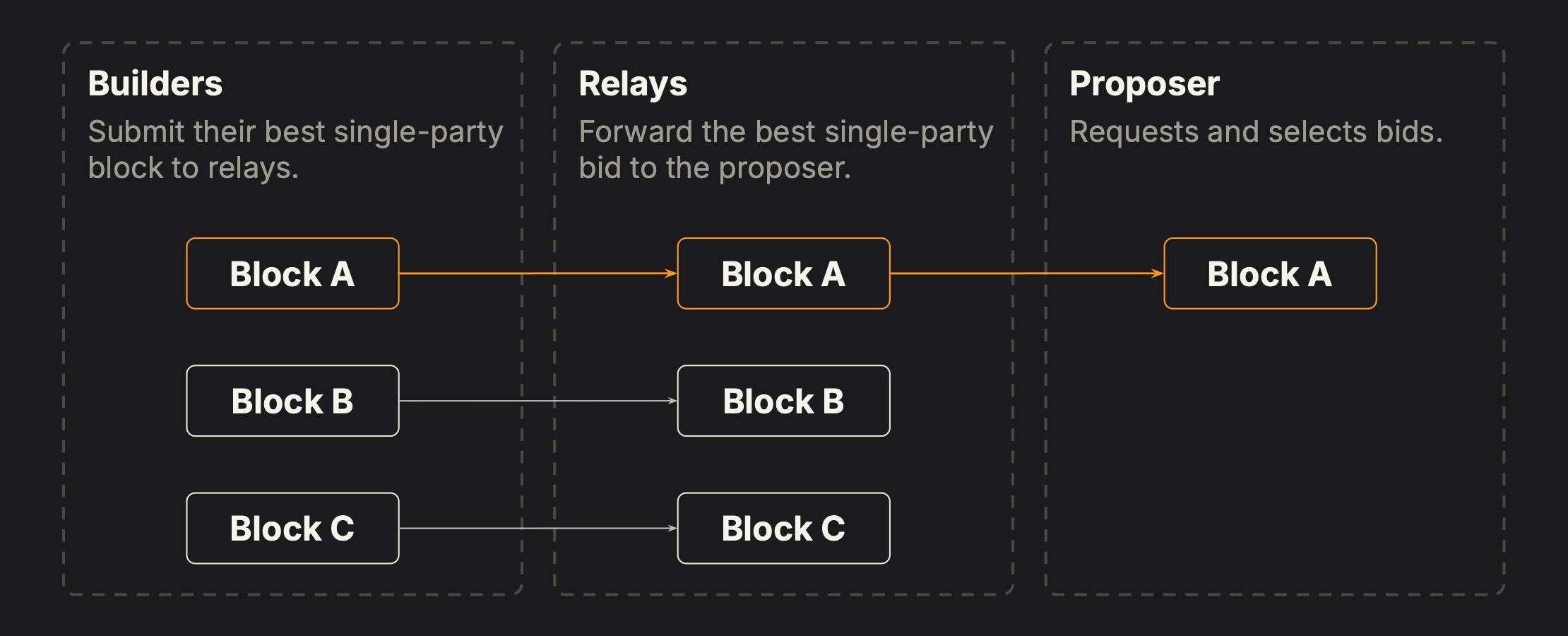
PBS proceeds in three stages:
- Builders build blocks from the transactions available to them and submit them to relays.
- Relays select the highest-paying block and forward it to the proposer.
- The proposer signs the highest-paying block it has received and the relay that has delivered it propagates it to the network.
Fundamentally and graphically, the single-party transaction pipeline is a straight line between one builder and the proposer. Any transactions not known to the builder that has constructed the winning block cannot be included in the slot.
The mempool and its decline
Historically, when a user sent a transaction from their wallet, it entered a waiting area called the mempool: a collection of pending transactions broadcast to the network but not yet included in a block.
The mempool is public. Anyone running a node can see every pending transaction, including its amount, destination, and fee. This visibility can leak information to participants who monitor it. If someone can see a large swap sitting in the mempool before it lands in a block, they can trade around it. Because of this, the mempool is declining.
The PBS transaction journey
Today, most sophisticated users and wallets avoid the mempool entirely. Instead, they send transactions through private RPCs and order flow auctions without exposing them publicly.
The result is a shift from a public commons to a network of private channels. The mempool still exists, but an increasing share of valuable transactions never touches it. Due to market dynamics, some originators started sharing transactions only with specific builders, which allows these to build more valuable blocks. This exclusive flow means that no single builder sees all transactions.
Structural gaps
Since the launch of PBS, gaps have emerged. The Blockspace Forum brought teams together to identify these across four dimensions:
- Robustness: While Ethereum produces the most robust blockspace on earth, +90% of transactions find Ethereum through PBS. Its original design has caused a concentrated builder and relay set to emerge raising the risk of correlated failures and limiting the parties who provide transaction inclusion impacting censorship resistance. A single builder for each block also holds discretion over each block, and validators require this builder's opt-in to offer services.
- Economics: Current incentives lead to exclusive flow. With this only transactions known to a single builder can be included. Key actors like relays also were designed to operate as public goods and rely on inefficient ad hoc value capture that reduces block value and increases risks for validators and the network.
- Performance: Due to exclusive order flow, transactions not known to the winning builder spill over to the next block, and users are left waiting longer and paying more in fees. Block propagation and bid provisioning also come with some increased risk and are heavily reliant on under-resourced relays.
- Services: Validators have lost autonomy and cannot offer differentiated services like fast inclusion.
As a result, Ethereum suffers from hampered UX and increased fragility, and leaves untapped potential on the table. For example, users frequently wait seconds longer for inclusion, blockspace is not allocated as effectively as it could be, leading to millions in forgone fees, and the risk of correlated failures and censorship has risen.